


At the moment, China is leading by a large margin in terms of sales of electric vehicles and hybrids. According to the expectations of the China Passenger Car Association, in 2023 this index may exceed 8.5 million units, which corresponds to an annual growth of 30%.
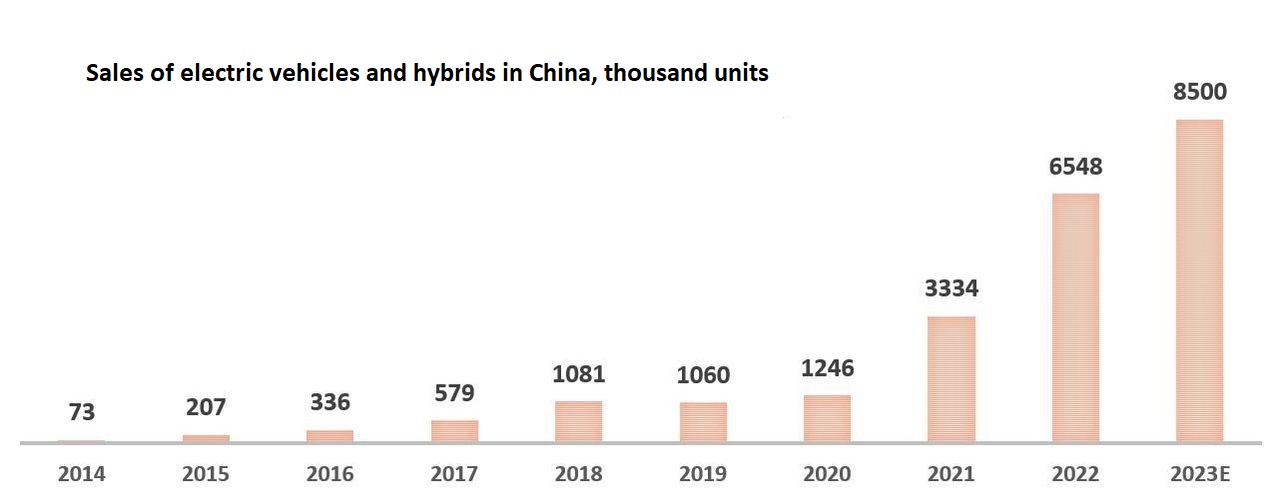 At the same time, we note that the growth is faster than expected. The Chinese government's five-year plan assumed that only by 2025 the share of sales of electric vehicles and hybrids would reach 20%. However, by the end of last year, their share reached 29% compared to 16% by the end of 2021. In the longer term, the Chinese government plans to increase the share of sales of electric vehicles in the so-called regions with the highest level of pollution to 50% by 2030 and up to 40% in other regions.
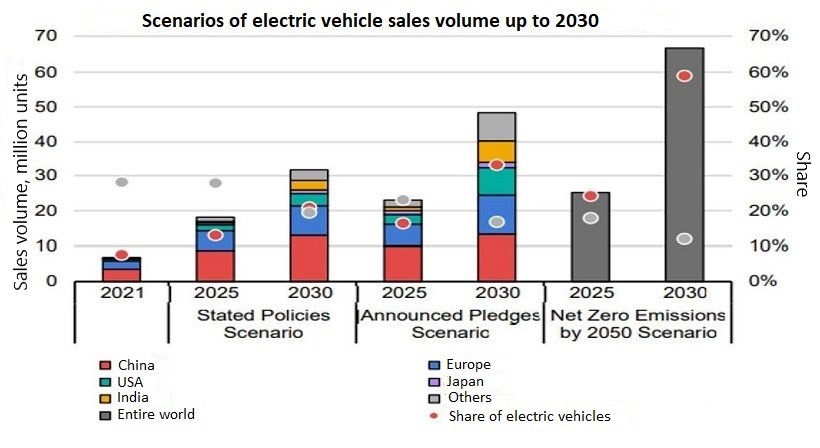
The IEA's long-term forecast looks similar, which assumes that by 2030 the share of electric vehicles in total sales will continuously grow due to the efforts of most countries to decarbonize and improve technologies in the industry. The Agency has developed three key scenarios that differ in the rate of decarbonization: Stated Policies (current government policies), Announced Pledges (announced government goals, for example on emissions) and Net Zero by 2050 (achieving carbon neutrality by 2050). Even in the most conservative scenario, the volume of sales of electric vehicles in China by 2030 could reach about 12 million — 40% more than the plan for the current year. At the same time, the growth will occur mainly due to an increase in the share of sales, which may reach about 45%.
 Source: IEA
Over the past year, lithium mining companies have been experiencing problems, as lithium carbonate prices in China have dropped by almost 50% relative to the highs of last autumn. The decline is mainly due to the correction of a relatively extremely high base — against the background of the boom of electric vehicles, the prices of lithium, which is used for the production of batteries, have sharply increased several times due to a shortage. However, against the background of supply growth in the next 2-3 years, the lithium market may be near the balance of supply and demand, which led to a cooling of prices.
At the same time, in the longer term, the world's leading agencies agree that without additional investments in mining, the lithium market will be steadily deficient against the background of growing demand from the electric vehicle industry. If in 2022 the demand for lithium carbonate was about 700 thousand tons, then by 2030, according to current forecasts, it could reach 2.5–3.0 million tons. We believe that expectations of a shortage in the long term will support lithium prices at an elevated level.


