


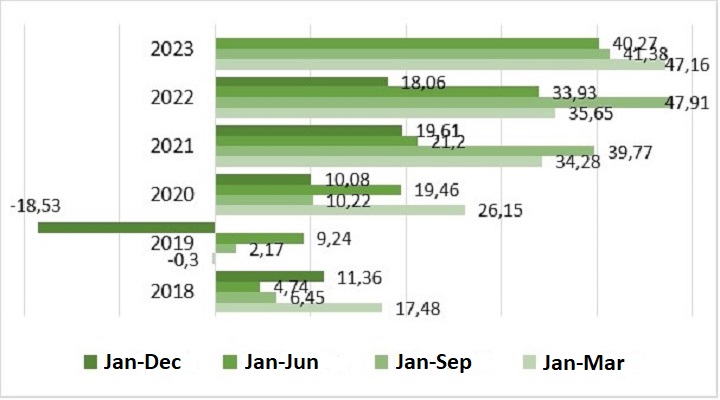
According to the results of 9 months of 2023, the profitability of the floriculture industry in Russia was up to 40.27%, which is the highest indicator for the same period over the past 6 years. And for the period 2018-2022, the indicator increased by 6.7 percentage points. Interagro analysts expect the level of profitability for 2023 at the level of 22.5%.
Industrial floriculture in Russia is characterized by gradual development. By the end of 2022, 381 million pieces of freshly cut flowers were produced in the country, according to the forecast of industry experts, the final figure for 2023 should be about 500 million pieces. The total area of cut flower cultivation greenhouses in Russia at the beginning of 2023 was 200 hectares, which is 17.6% more than in 2017.
According to the executive director of the National Association of Flower Growers, the companies that are part of the association have an additional 147 hectares of unused land, with the introduction of which flower production can get a new round in development and will more than double. State support plays a central role in increasing capacity, at the moment it turns out to be in the form of preferential loans, which manufacturers can also direct to the introduction of digital technologies and automation of production.
"At this stage, the niche of floriculture in the country can be called relatively free," comments Natalia Davydenko, head of the "Crop production" department of the Interagro Group of companies. – Large floriculture producers are located mainly in the regions of the Central Federal District and the Volga Federal District, which account for more than half of fresh cut flowers. In general, market growth is expected, among other things, due to the expansion of existing and construction of new greenhouses."
For example, in the Republic of Mordovia in 2023, Mir Tsvetov Group opened a new greenhouse complex for growing roses, the company's production will increase by 30%, to 50 million pcs. The Udmurt company Tsvetopolis plans to increase production capacity to 15 million flowers per year through the construction of a new unit of greenhouses, the launch of which is scheduled for the end of 2024. A flower cluster will appear in the Kaluga region, where about 25% of the total volume of flowers is grown. This agreement was signed between the management of Galantus and Kaluga Flower Holding at the opening ceremony of the Kaluga Autumn Fair.
According to Rosstat, in 2022, Russian agricultural organizations produced 1.9 million pieces of bulbs, corms and rhizomes of flowers. However, the main planting material for growing in Russia is still imported from abroad. The Association "Greenhouses of Russia" notes the importance of creating new greenhouses in the country to ensure its own production of planting material. One of the promising steps in this direction is microclonal reproduction, which allows you to increase own production without imports. This method provides an opportunity to grow large quantities of high-quality plants, preserving their genetic purity and resistance to diseases, which ultimately contributes to improving the efficiency of agricultural production in Russia.
Supply volume
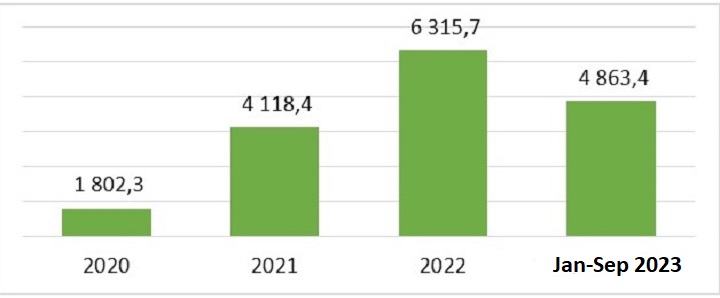
Chart 1 The volume of supplies in the floriculture industry, million rubles.
Source: Rosstat
In January-September 2023, the volume of flowers supplied amounted to 4.9 billion rubles. In value terms, in 2020-2022, the industry showed positive trends and grew 3.5 times in three years, to 6.3 billion rubles. The sanctions and restrictions imposed against Russia in 2022 did not cause a decline in this segment, on the contrary, the industry showed an increase of 1.5 times compared to the previous period.
Profitability
Graph 2. Profitability of the floriculture industry, %
Source: Rosstat
In 2019, in addition to paying a single agricultural tax of 6%, flower growers began to pay VAT at a rate of 20%, which immediately affected profitability. However, despite the harsh lockdown imposed in most countries in 2020 and the international sanctions of 2022 against Russia, the industry has nevertheless rehabilitated itself – according to the results of 9 months of 2023, profitability amounted to 40.27%, which is the maximum for the same period over the past 6 years. And over the period 2018-2022, the indicator increased by 6.7 percentage points. Manufacturers have adapted to work in new conditions, Interagro analysts expect a profitability level of 22.5% in 2023.
The cost of freshly cut flowers
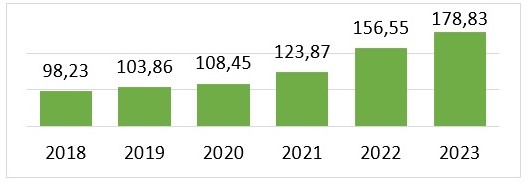
Graph 3. Average consumer prices for freshly cut flowers, RUB/piece.
Source: Rosstat
According to official statistics, over the past 6 years, the average cost of freshly cut flowers in the consumer market has increased 1.8 times, from 98.23 rubles/piece in 2018 to 178.83 rubles/piece in 2023. In 2023, one flower cost the consumer 14.2% more than a year earlier. There is a pronounced growth trend, which, according to market experts, is due to an increase in sales prices of growers, an increase in the cost of logistics, tariffs and employee salaries.
Import of freshly cut flowers
The floriculture market in the country is formed mainly due to the imports. According to the latest data from the Federal Customs Service, over 1.7 billion pieces of cut flowers are imported into Russia annually, since 2018 this number has increased by 34.9%. A decrease in imports to 1.08 billion units is noted in 2020, which is due to restrictions adopted by many governments in order to prevent the spread of corona virus infection.
The peak demand for flowers is noticed on February 14, March 8 and September 1, respectively, more products are imported during this period. So, according to the Federal Customs Service, on the eve of International Women's Day, from 390 to 730 tons of freshly cut flowers were imported daily, and before September 1, 6.4 thousand tons of products worth more than 45.8 million US dollars were delivered. The Netherlands, Ecuador and Kenya accounted for the largest share of imports. Roses, chrysanthemums, carnations and tulips were most often imported from abroad.
According to Victoria Abramchenko, Deputy Prime Minister of the Russian Federation, flower supplies from Europe and the Netherlands remained at the level of 2022.


